


The old-fashioned bike of yesteryear is today’s workhorse. Hardly any other mode of transportation has enjoyed such popularity in recent years as the bicycle. The boom shows no signs of slowing down; bikes are getting better and better technically, and even longer distances are no longer a problem.
That’s why almost every cyclist soon finds themselves wondering how best to store items like cell phones, wallets, sweaters, jackets, or even their daily groceries safely and securely. Of course, there are now bike bags available for almost every purpose. It always depends on what I really need them for. When it comes to bike bags, it’s about comfortable mobility on the one hand and safety for yourself and others on the other. A bag that isn’t properly mounted and is also overloaded can lead to serious falls. We’d like to provide a brief overview of the most commonly used bike bags along with related information and tips.
Which bike bags for which cyclists
Since everyone has their own ideas about how they get around on their bike, we’d like to highlight a few “typical” cyclists. There are the recreational cyclists, often riding trekking bikes, equipped with a full lighting system and a rack. Housewives on their city bikes are similarly equipped. Then there are the more dedicated mountain bike and full-suspension riders who use their bikes several times a week after work for a sporty ride. Just like the road or cross-country cyclists who prioritize high speed and range or who want to ride over gravel with their narrow tires. And of course, there are now e-bike riders in every category, whose numbers have skyrocketed in recent years.
The good news is that, without exception, there’s the right bag for every type of cyclist and bike.
A brief list of practical bike bags:
- Rear panniers or rack bags
- Front panniers
- Saddle bags
- Cell phone bags
- Triangle bags or frame bags
A brief summary of each type of bag is provided to help you make the right choice.
Rear panniers or rack bags
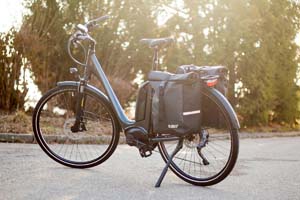
A now very popular and proven way to carry your luggage on both sides of the rack. Most of these “side bags” feature an Easy-Click system, allowing the bags to be attached to or removed from the rack in seconds. These bags offer a total capacity of more than 40 liters on average when both bags are used. Since these bags are completely separate from one another, they can also be used individually. It’s especially important with these bags to always pay attention to the weight. This is ideal, of course, when using both bags, as the contents can be distributed evenly on both sides. These bags are not only suitable for long bike tours with a lot of luggage but also for daily shopping. The higher-quality bags are, of course, splash-proof and can easily withstand a prolonged rain shower. Thanks to straps attached to the sides, they can also be carried as shoulder bags while shopping. They are most commonly used by trekking or city bike riders. When paired with a high-quality luggage rack, they are an indispensable part of a globetrotter’s or long-distance cyclist’s gear.
Front panniers
These bags are basically similar in style to rear panniers. With front panniers, however, there are a few things to keep in mind that play only a minor role when carrying loads on a luggage rack. Front panniers must not be loaded with too much weight, and the load must always be balanced. After all, on most bicycles, the steering is located at the front. This means that the bag, including its load, must always move with the steering. A rule of thumb states that the load should always be distributed with a maximum of one-third on the front wheel and two-thirds on the rear wheel to ensure proper balance. Front wheel bags are therefore designed only for light weight and small luggage. Consequently, the number of people using front panniers is relatively low. The bike must remain easy to steer and maneuver at all times.
Saddle bags
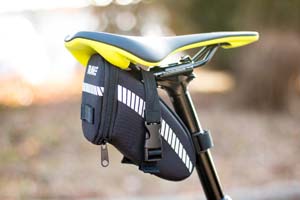
These bags, which are usually quite small, have enjoyed great popularity for many years because they can, in principle, be attached to any bicycle. They are barely visible yet serve as valuable little helpers when it comes to keeping essentials like a cell phone, wallet, loose change, or even tools and a repair kit with you at all times. They are usually easily attached under the saddle using Velcro straps, are very lightweight, and do not interfere with riding in any way. Mountain bikers and road cyclists also often rely on these small bags, since panniers are naturally not an option for these types of bikes. These bags often offer a surprising amount of storage space inside, are water-resistant, and even feature a mount for a rear light.
Cell Phone Pockets
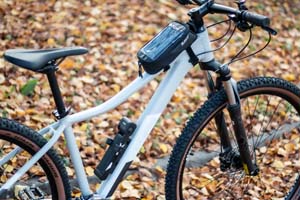
Of course, you can’t go biking without your cell phone. As mentioned earlier, if your phone doesn’t exceed a certain size, it can be stowed in the saddle bag. However, a cell phone bag specifically designed for the bike frame is a better option. It attaches to the top tube and stem using so-called “strips” (Velcro straps), ensuring a very secure fit. The phone pouch is suitable for carrying smaller items, such as a wallet, repair kit, or even a power bank, so you can charge your phone at any time. These high-quality bags can accommodate phones of almost any size in the designated slot in the lid, naturally protected from splashes and equipped with a transparent plastic cover that allows you to operate the phone’s touchscreen directly without any issues. This way, the phone can either be used fully via the headset or serve as a navigation device for the ride.
Triangle bags or frame bags
The name is no coincidence, as these bags are always triangular in shape. They are suitable for carrying smaller items or accessories and are attached directly to the triangle of the frame, below the handlebars, using Velcro straps. They are barely visible and are hardly noticeable even while cycling because they blend in with the frame, almost hidden. They usually feature multiple storage options. An inner pocket for a surprising amount of small items and outer pockets for additional gear, naturally usually splash-proof.
Conclusion:
Generally speaking, you can assume that bike bags manufactured today are weatherproof. The material may vary. A bike bag should look stylish, be made of durable material, and have a high-quality zipper so you can enjoy it for many years. Polyester, plastic, nylon, or even truck tarpaulin are often used. The mounting hardware should also be tear-resistant to prevent losing the bag during your ride. How much storage space you need is a personal decision. Often, multiple bags are used simultaneously or swapped out as needed, which is very easy to do thanks to the commonly used Velcro systems.